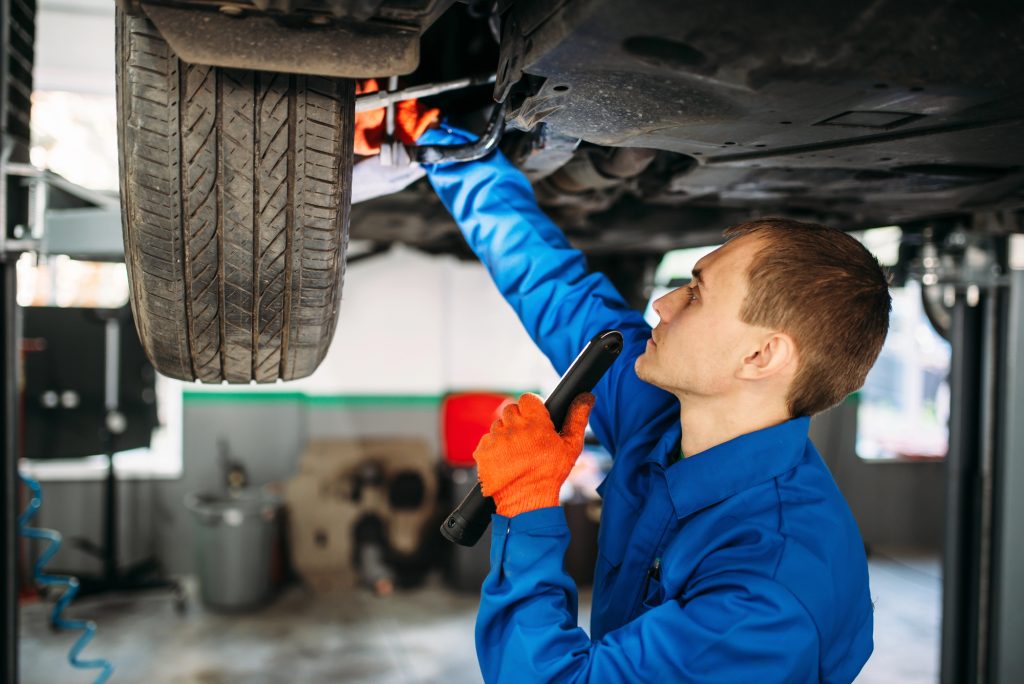
Why Suspension Maintenance Is a Safety Issue
Your tires are the only contact between your vehicle and the road. The suspension’s job is to keep that contact steady. When the suspension is healthy, your vehicle feels stable, corners with control, and stays composed when you brake or swerve. When it is worn, the tire can lose consistent grip, especially over bumps, dips, and uneven pavement.
A well-maintained suspension supports safety by:
- Keeping the tire contact patch consistent for traction
- Reducing body roll in turns and nose dive under braking
- Helping your steering stay precise instead of vague or wandering
- Minimizing wheel hop or bouncing that can reduce control
The Key Parts in Auto Suspension Servicing and What Wear Looks Like
Shocks and Struts
Shocks and struts control suspension movement. They prevent excessive bouncing and help keep the vehicle stable when you brake, turn, or hit rough roads. Struts also play a structural role in many vehicles, so wear can affect alignment and handling.
Common signs your shocks or struts may be worn:
- Your vehicle bounces more than normal after bumps
- The front end dips hard when braking
- The vehicle feels unstable on the highway, especially in wind
- You notice uneven tire tread wear or cupping
Worn shocks and struts do not always fail loudly. Many drivers adapt to the change slowly, until they hit a pothole or have to brake hard and realize the vehicle no longer feels controlled.
Ball Joints
Ball joints allow your suspension and steering to move smoothly while supporting the vehicle’s weight. They are critical pivot points. When they wear, steering accuracy and stability can suffer.
Warning signs of ball joint issues include:
- Clunking or knocking noises over bumps
- Steering that feels loose or wanders
- Uneven tire wear, sometimes more noticeable on one edge
- Vibration or instability as speed increases
Ball joints can also be affected by torn boots and loss of lubrication, which is why regular inspection matters.
Control Arms and Bushings
Control arms connect the wheel assembly to the frame and help keep the wheel in the correct position as the suspension moves. Bushings absorb vibration and help maintain alignment angles under load. When bushings crack or loosen, the wheel can shift slightly during braking, accelerating, or cornering.
Common signs of control arm or bushing wear:
- Pulling left or right, especially during braking
- Clunks or thuds when going over bumps
- Steering that feels inconsistent or twitchy
- Tire wear that shows alignment changes over time
If your vehicle feels fine on smooth roads but unstable on rough surfaces, worn control arm bushings are often worth checking.
Tire Tread Tells the Truth
Your tire tread is often the first visible clue that your suspension is not doing its job. Suspension problems and alignment issues tend to show up on the tire before the vehicle becomes obviously hard to control.
Look for these patterns:
- Cupping or scalloping: often linked to weak shocks or struts that are not controlling bounce
- Inside or outside edge wear: can indicate alignment changes caused by worn suspension parts or pothole impacts
- Feathering or uneven wear across the tread: can point to geometry issues that may involve control arms, ball joints, or alignment
Low tread also makes pothole hits worse. With less rubber to absorb impact and less grip available, any suspension weakness becomes more noticeable and more risky.
Why Potholes Speed Up Suspension Damage
Potholes create sharp, high-force impacts. Even if you do not bend a wheel, the force can stress suspension components and knock alignment out of spec. If a part is already worn, a pothole can be the moment it starts making noise, pulling, or causing tire wear.
After a hard pothole hit, you should pay attention to:
- New vibrations through the steering wheel
- A sudden pull or crooked steering wheel
- Fresh clunking noises over bumps
- Rapid change in tire tread wear or a new “wobble” feeling
In Ames, Huxley, Nevada, Story City, Gilbert, Boone, Kelley and Slater, where rough patches and potholes can be seasonal, getting a quick suspension and alignment check after a big hit is a smart safety move.
When to Schedule Auto Suspension Servicing
Use this checklist. If you notice one or more of these, it is time for an inspection:
- Clunking over bumps or when turning
- Vehicle pulls left or right on a flat road
- Steering feels loose, wandering, or overly sensitive
- Excessive bouncing after bumps
- Uneven tire tread wear or cupping
- Vehicle feels unstable when braking or changing lanes
- You recently hit a pothole hard enough to feel it in the steering wheel
What a Proper Suspension Inspection Should Include
A real suspension service is not guesswork. A solid inspection should include:
- Visual checks for leaking struts/shocks, torn boots, and cracked bushings
- Physical checks for play in ball joints and control arm movement
- Tire tread measurement and evaluation of wear patterns
- Road test observations tied to handling and braking behavior
- Alignment recommendations when symptoms or wear patterns suggest it
Catching wear early usually protects your tires and prevents a small handling issue from becoming a bigger safety problem.
Schedule Suspension Service at Ron’s Auto Repair Center
If your vehicle feels bouncy, pulls to one side, clunks over bumps, or started acting up after a pothole hit, do not ignore it. Auto suspension servicing protects your control, your tire tread, and your safety on the road in Ames, Huxley, Nevada, Story City, Gilbert, Boone, Kelley and Slater, where rough pavement is a common reality. Call Ron’s Auto Repair Center to book an appointment at (515) 232-8555.